Second 2.8L Duramax Used Oil Analysis
I recently sent in my second oil sample for analysis, if you read my first UOA post you know that at just over 1000 miles, I drained the factory oil and put 6 quarts of Amsoil European 5w30 oil in. Why would I put “European oil” in a Duramax?
First, this 2.8L Duramax is a little different from its big brothers. This engine was designed and is assembled in Thailand.
Second, these engines are in vehicles equipped with what can be generally referred to as “exhaust after-treatment.” Diesels have always had two main emissions issues - NOx and soot, or particulate matter.
NOx (nitrides of oxygen) are one of the main components of acid rain and they are created by both gasoline and diesel engines at high combustion temperatures. It’s more of a problem for diesel because diesel combustion temperatures tend to be a few hundred degrees F higher than gasoline. One of the ways this is combated with both fuel types is with EGR - Exhaust Gas Recirculation. At first thought, this may sound counter-intuitive - recirculating exhaust gasses back into the combustion chamber sounds like it would raise the temperature. In reality, this actually helps to reduce temperature because exhaust is mostly inert - meaning it contains very little oxygen compared to fresh air. This effectively reduces the amount of fuel that can be burned and less fuel burned means less heat produced. The second way NOx emissions are reduced, specifically with diesel engines, is to catalyze excess NOx in the exhaust stream. This is done using a system called SCR - Selective Catalyst Reduction. In short, this injects DEF - Diesel Exhaust Fluid, which is 1/3 urea and 2/3 water into a catalyst, which reacts with NOx to neutralize it and produce water and CO2, which are less harmful to the atmosphere.
Soot, or particulate matter, is the result of incomplete combustion. Just like a cold camp fire or a cheap candle produces black smoke, so does incomplete combustion of diesel fuel. This is normally seen as grey/black smoke emitted from the exhaust system. These particles are filtered out of the exhaust stream by the DPF - diesel particulate filter. The amount of soot produced by a diesel engine is too much for a paper disposable filter like the one which filters the air coming into the engine to be cost effective. Instead, modern DPFs are designed to “regenerate” or, be cleaned, by increasing the exhaust temperature to 1000 degrees F or more to literally burn away the soot.
However, some other particles cannot be burned away to clean the DPF, which will reduce the flow, harm performance and eventually require intervention. Ash is an example of another particle which could end up in the exhaust stream, be trapped by the DPF, but not burned away during regeneration.
One common source of such ash, is the engine oil. Small amounts of oil, such as the very thin film left on the cylinder walls as the piston moves up and down in the bore or oil vapor/mist which is ingested into the intake stream via the PCV - Positive Crankcase Ventilation, which exists to prevent pressure from building in the crankcase as the pistons move up and down and small amounts of combustion gasses pass the piston rings. Because these hydrocarbons are pollutants, the PCV system uses the vacuum created by the engine to pull these gasses and vapors out of the crank case and burn them.
Typically, engine oil additives contain an additive package including phosphorous and sulfur, which are used as detergents, anti-wear and antioxidants. They are the main components which contribute to an oil’s TBN - Total Base Number. A high TBN typically means the oil will have a longer life, as it has more of these additives to counteract the acids created when water vapor in the air combines with the byproducts of combustion. However, these additives create ash when burned, and ash can’t be removed from the DPF by normal means. This will eventually cause the DPF to become clogged and required replacement. For this reason, specific engine oil should be selected for engines which use these exhaust after-treatment systems.
The characteristics you should look for are:
Low SAPS - contains low amounts of phosphorous and sulphur Low NOACK volatility - refers to the tendency of the oil to vaporize when heated
As diesel engines have been more common in Europe and European manufacturers have required these characteristics for some time, Amsoil European Car Formula is formulated specifically to meet European manufacturer specifications, which also happens to satisfy the dexos2 specification required for GM’s 2.8L Duramax engine.
See the below image for the UOA result.
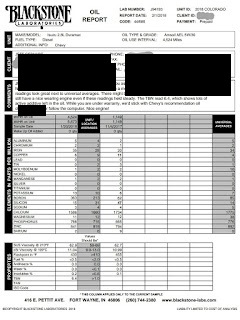
With a TBN of 6.4, there’s plenty of life left in this oil, which isn’t surprising after only about 4000 miles. However, as alternative additives are required to increase the TBN in a low SAPS oil, the engine being relatively new to GM in general (with this being it’s 3rd year in the US) and with it being a brand new engine, I found value in monitoring the health of the engine as it breaks in as I intend to keep the truck for as long as it’s good to me.
My next oil change interval will either be at 7500 miles (the manufacturer recommended interval) or whenever the computer tells me to change it.
If you have any questions about what oil is appropriate for your vehicle, please feel free to comment or reach out via the site contact form and I’d be happy to find Amsoil’s recommended products for your application.
Originally published on MidMichigan Oil LLC, independent AMSOIL dealer, restored from archive.